Posts

Book Design & Production by Elizabeth Burke

Image
Copyright 1994 Boston Athenaum Library, Boston, MA. Design and production by Elizabeth M. Burke. Copyright 1992 Kenneth Rosen. Designed and edited by Elizabeth M. Burke. Printed at the Ascensius Press, Maine. Other books I've copyedited, designed or produced: Barthel, Diane. The Preservation Project. New Jersey: Rutgers University Press. Germain, Sylvia. The Book of Nights. Boston, MA: David R. Godine Publisher. Kennedy, Rick, ed. Aristotelian and Cartesian Logic at Harvard: Charles Morton's a Logick System & William Brattle's Compendium of Logick. The Colonial Society of Massachusetts Mundy, James. No Rich Men's Sons. Maine: Harp Publications, 1996 Patten, Robert L. George Cruikshank's Life, Times, and Art. Vol 2. New Jersey: Rutgers University Press. Zallen, Doris K. Does It Run in the Family. Consumer's Guide to DNA Testing for Genetic Disorders. New Jersey: Rutgers University Press, 1997.
Long Island, ME: Summer Recycling Creativity 2007

Architects are taking old train crates to make homes. Someone has turned old vinyl records into bowls. Someone else has come up with a lighter-weight "concrete block" for building houses with, by mixing concrete with chewed up styrofoam from styrofoam cups and the like. People make shoes out of cut-up tires. And then there are people who take old furniture and rehabilitate it, or use the wood to create something new. Your mission for this summer class is to come up with ideas, concepts, and then a project for stuff that washes up on the beaches or is on Long Island already. Yep ... recycling. Or, alternately, to come up with an idea about how Long Island can recycle its own everyday "waste" into products. You will come up with not just an idea, but work to transform that idea into a product. You will be engaged in politics, social policy, beliefs, engineering, design, and creativity: first to some up with an idea, then to transform the idea, and all during this proc...

Book Design 1: Letterpress Printing & Creativity

Image
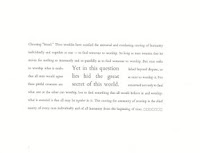
In 1990, I worked with a letterpress shop and the Portland School of Art, with a group of talented students interested in book design and the old-world art of letterpress. I wanted the students to learn more than skill; I wanted them to try to turn the words of a great mind and soul into something worthy of great skill. The work exhibited in the next two slides shows not only how clever they were individually, but how they inherently, long before the "team" work skills became so prevalent in our US of A, did what could be nothing less than brilliant as a team. I gave the assignment, but they did the work, and it was very fine work.

Images and Arrangements

Image

landscape and identity

Image
This is an image taken from a dream, but surely someone knows the feeling of swimming at night, and that is not a dream. To swim at night, in the ocean or a lake, tell me, what is the feeling? What images would you use to describe your sensations and your thoughts? This image is one I have worked over and over, erasing and redrawing, since 1997, and it is now 2007 -- so for ten years. For me, it holds some of the mystery of swimming at night. A person, an animal, a house: the shadows a bit obscure, but the sense of containment and wildness there.

continuing ... memory and architecture

Image
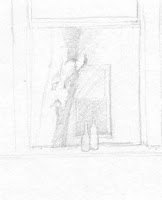
Window and tree, or windows and tree ... views from one way considered from another. When did I do this image? When would someone else have done this image, or wanted this sort of image? When would someone want an image of a tree caught between two windows, on either side of an architectural/continental divide? I did it when I was thinking of going into medicine, after a life-time of wanting/hoping to be a writer, or its defunct (to me), a painter: A person who had the fantasy of being noticably by what she had to say. As a painter, it was as someone who was noticable by what she could image forth. No one wants to be "something" (a painter, a writer, an accountant, etc), without wanting to be noticed for something, or at least to have experienced at some point that one's skills were well put. One hardly waits around to be nothing. And yet, recently, I found myself strangely overjoyed by a small moment in the movie Man on a Train, where the poetry teacher in a small French...

memory and architecture

Image
It is both the arrangement of images/things in our day-to-day lives and in our dreams that leads us to what is compelling us either toward death or toward life. It isn't the things or the images, but how we arrange them--that say something about how we live. Archeology, the prototype for psychoanalysis, really is about studying how things were arranged, so that someone later made an hypothesis about what a culture or civilization valued and how they lived. How we order what we order, or arrange, speaks of our values and desires. These images are not simply images, but arrangements, orderings, and implications.

The Diary Worth Publishing

I've kept a personal journal for years, and about 15 years ago started rereading and then trashing journals from childhood. Really, they were incredibly boring, repetitious, obsessive. I reread them for my own memories, but felt they simply wouldn't be things I'd like to leave for others to read. There are journals worth reading. The writings of Winston Churchill, of Virginia Woolf, the diaries of Anais Nin, or the journals as novels of Doris Lessing. However, I've always wanted to have some sort of worthy journal. One friend notes down all the books he's read, movie he's seen, etc., and he makes small notes to himself about his impressions. So: Diamond, Jared. (2005). Collapse. NY: Penguin Press Science. I read this after having read a manuscript about anxiety disorders, written by a bright and interesting psychiatrist, with whom I'd hope to work on a manuscript, as a copyeditor, editor, co-writer. I started delving back into genetics, biochemistry, etc, ha...

Copyright

This site and contents, unless otherwise noted, copyright © Elizabeth M. Burke 2007 and beyond - all rights reserved. The use of any image or text on any internet site, is not allowed unless written authorization is obtained from Elizabeth M. Burke, or material is in quotes, and attributed to me. Use of my writing or images which sets up the appearance that I have authored any other internet site or material is fraudulent.

House of Grass

Image
Have you ever fallen asleep in the grass, or in the woods, on a warm, slightly breezy day? It's the most delicious experience to feel that safe in nature. Copyright 2007 Elizabeth M. Burke

Where Are All the Children?

I don’t see children playing outside these days. Not even in rural areas. On sunny, snowy winters, I’d expect to see children out sledding, building snow forts, or skating. In the summers, I wonder why I don’t see children out playing kick the can, or any of the myriad of other games children create when they get together. I’m not the only one who has noticed this. My adult friends say the same. I’ve seen more elderly and middle-aged people outdoors—sledding, flying down a hill, laughing, arms in the air, and then trudging back up the hill, their skin looking healthily flushed, faces open with smiles. I’ve seen middle-aged men out playing with a remote control toy airplane. You could tell from their body language they were having fun. In my youth, kids went outside after school. We were physically very active and healthy. We learned through each other the rules of fair play. We became concerned about changes in our neighborhood that affected our playing fields. We gained in coordinatio...

Elizabeth Burke, LCSW. Maine psychotherapist

Anxiety has been treated for years as an individual medical problem, but it has also been treated as a problem related to a stressful environment. Therapists and doctors recognize the role stress has in our lives, even if they don't focus much on the systems we live in. They more often focus on how you as an individual manage the stress. I think it is important to look at both issues, because I believe environments and systems (people systems, work systems, community systems) can be very stress inducing. We think we "should" be able to handle stressful environments, without wondering whether in fact we have created environments we are not really well able to adapt to. It's an odd question to ask one's self: How is it humans could create systems and environments they aren't really well suited to--spiritually or health wise? But I think it is an important question to ask. In fact, humans have created systems of living that end up collapsing. In my work with peop...

Nature Images

Image
The first image is a wood block print, two-color. The second is of a species of Datura that has arrived at the beaches of Long Island, Maine--an new arrival. It is a watercolor. Creativity is not just imagining things, but being attentive, and allowing our individually honed perceptions to find expression.

Unique Hand-Painted Rooms

Image
When people think about decorating their homes, they often think about "buying" things, and getting things finished. But a home can be an expression of deep needs for belonging and being able to express the self without fear of judgment. As much as a a house may belong to us, we may wonder if we belong to a home. It can be extremely therapeutic to consider one's home a process of self and family expression, rather than a showroom for someone else's design, or a showroom of market determined values. If you're decorating or modeling your house thinking only of its resale value, can you truly feel "at home"? Are you afraid that if you hand-paint a wall, as this wall in the picture, someone else will think your house "too funky"? Ah, as long as the walls are intact, the cellar dry, the electric wiring good, the plumbing operational, why not express yourself fully? You can repaint that wall before selling your house. But I also believe that a home w...

the Yurt

Image
The Yurt : July 13, 2006 This is my 20 foot-wide yurt on an island off the coast of Portland, Maine. It doesn't look like much from the outside, but inside is a mystery of light and space. I built it as a means to have a place I could live in when others were using my family's cabin, because I want to live simply during months when it is feasible. The aesthetics of living in a building where you can hear the birds, the ocean, the wind--all very clearly--is very different from those of living in a building where you hear televisions, cars, loud music you may or may not like. Living without electricity really gets you to think about energy and light. Living without running water really gets you to think about how much water you use daily generally when in contemporary housing. That awareness can bring a greater appreciation and value to resources we take for granted. Summer 2006 readings: Gawande, Atul. "The Malpractice Mess: Dealing with Doctors' Mistakes." (2005, ...