Posts

The Victory Garden versus Fashion in Paris

Some people are paying more attention to their gardens, and becoming more "English," making sure they've got vegetables growing some place. They're chasing out "rodents"--whether deer, gophers, rabbits, or whatever. It's as if we've entered the Victory Garden era again, except there's no victory. We're thankfully pulling out, if slowly, from our long war in the Middle East, and trying to understand what that might mean for us--shoring up homeland security, and more hopefully throwing our wits and intelligence into non-fossil fuel energy. What we've got is a Depression, not a Recession, and there's no one daring to say this, but, still, even people with good managerial jobs are paying attention to things like how much tinfoil they use, or how to use the plastic baggies from the grocery story to store their food in, rather than buying new plastic ziplock baggies. It's so disconcerting to read articles on the New York Times' ...

Singing Sands Beach

The Burkes have created a wonderful blog regarding the 9 acres of land they have owned since 1954--which includes Singing Sands Beach (to the low water mark--whereever the water is at the moment), and the last 1/3 or so of Andrew's Beach, also called South Beach. It is private property, and visitors are asked to contact the owners if they wish to visit. The owners will be closing the beach to all public use from time to time.

Webesthetics ©

Image
The art of book making, or of any readable/visual material is about visual interest and ease. I can't count the number of web sites I've visited where the choice of typography and the spacing between lines of type is entirely uninformed, or where the design of the web site is uninformed. The options available for type on this site are limited, also, and that is frustrating. The more we spend time reading things on computers, the more visual ergonomics is going to be a crucial issue. What is wonderful about a two-page book that was well designed was that facing pages were harmonious--so one could read one page without being distracted with what was on the facing page. Furthermore, a two-page book allowed one to have one's eyes shielded by extraneous visual data about one. Not true for web pages, Kindle, or any of the new computer formats. Even if one views things that are set up as a two-page spread, the pages are flatly presented, so visual distraction is easy. Remarkably e...

Living Designs: The Portland, Maine mural by Elizabeth Morrill Burke

Living Designs: The Portland, Maine mural by Elizabeth Morrill Burke

The Portland, Maine mural by Elizabeth Morrill Burke

see: http://www.wlbz2.com/news/local/story.aspx?storyid=94110 An artist's trajectory: from a bachelor's in literature, to a 1/2 year in a Ph.D. program in Comparative Literature at the University of Wisconsin, Madison, back to her undergraduate university (UCSC) to study art on her own for a year, living and working out of the ground floor of a rain-flooded barn, to getting accepted to a second BA program in art, but also, at the same time, getting accepted into the 5th year (post-grad) program in studio art at UCSC; returning to homeland Maine where she was granted one of the two slots for Maine painters into the coveted Maine fellows program at Skowhegan School of Painting & Sculpture, moving on to an MFA program in fine arts at Boston University, graduating only to find herself trying to make a living designing, copyediting, editing and producing books ... and then 15 years of null-hood in either painting or writing (premedical studies and a MSW and LCSW) ... not worki...

Mural Painting--a small life enlarged.

I've been hired to paint a huge mural in Portland, Maine, through the company I work with, Peerless Painting. The size is material: the wall I'm painting is 110 feet wide and approximately 60 feet high, and the image covers about 100 feet x 50 feet. Where: the Ocean Gateway Parking garage at the corner of India and Fore Streets in Portland, Maine. The City of Portland required the owner of the building to put an image up. The owners chose a section of a panaramic image taken by a photographer in 1910 of the Portland harbor (Casco Bay) from the Eastern Promenade on a day when half of all the six-masted schooners ever built were in the harbor, and this section shows those schooners. It also shows Fort Gorges, some of Peaks Island, Little Diamond, and Cushing Island, and of course other boats in the harbor at the time. While this has been a company "team" undertaking, I have done all the historical research for the image, and most of the drawing and painting, nevermind m...

Fishing & Houses Don't Move

The short stories previously published here have morphed into a novel, or are trying to. Sixty thousand words so far, and counting, and then figuring after proper editing, I'll have to start fresh. To give me a bit of sense of accomplishment, after months of slogging, publishing here a poem I've slogged through enough. Fishing There must be a way to move that doesn’t involve every lead sinker I’ve laid down to catch beasts I turn around and sell. I keep hoping I’ll haul—what? Something that will make the day feel more than how. There must be a way to come home with more than how to get a check, another way to see all these buoys, ropes, depth sounders and maps with cigarette burns just where I needed to see the depth. I keep coming up with the litter we make, mucking up the seas, as if we had nothing better to do than make things we throw away, eventually. I came to this life at sea because I loved it, but love gets tired and worn to ache and age, and I wonder. What would it be...

Possibilities

Possibilities Truths don't leap out of the darkness these days. Even the meteorite shower last night got me only half way to where you left off, at the "probably not." Though that seared through the atmosphere like the punctuation of a typewriter--you could feel the bump it left--I wasn't convinced. I could sit here for a million nights and not know anything I most want to know, such as whether the New York Times freezes to your driveway before you get up to retrieve it, or if when I use one of the words in the dictionary for the very literate you gave me you'll stop to wonder what you're doing and I'll know that. If these are magical imaginings, they know their desires. Will there be no more of love's enigmas of arrival, the way waves move outwardly when a boat docks inwardly, the way words pull time forward as they describe time backwards, the way subatomic particles know space so well they end up where they began, and we don't have a clue ...

Some Summer's Work

Image
"Traps." Oil on panel. This is a 3/4 fragment of the entire image. "Skee's Dream." Oil on panel. Another 3/4 fragment of entire image. "The Annunciation." Oil on panel. Another 3/4 fragment of entire image.

cars and the sea

Image

Chapter 1b draft: Life at Sea

Two weeks ago, I had been alternating between jobs as a sternman on a lobster boat. In one position, I was opening lobster traps, pulling out lobsters to put into a keeper's tank or throwing others back into the ocean, throwing various sized and species of crabs, sponges, or sea-squirts back into the ocean, or perhaps small sharks called dogfish, then passing on a trap to a stern-mate, and then finally banding keeper lobsters--those big enough to pass as mature-enough lobsters to sell to eat. In the second position, I received an open trap, strung dead fish on a bait line in the trap, closed the trap, and swung the 90 plus pound trap onto a table-like contraption in the stern of a boat, in a certain configuration. We wanted a string of four, or seven or eight traps, when the captain was ready to set a line of traps, to slide off the back of the boat in an orderly way without all the ropes getting entangled. My captain had started using five-foot traps, whose weight is of less issue...

Chapter 1 draft: Life at Sea

In 1992, two artists comrades and myself drove to New York City to see a few shows and visit some galleries. I parked my Volvo station-wagon on Prince Street, or thereabouts, as I recall, between SoHo and Chinatown. When we returned, my camera, my Ricoh manual, entirely manual, had been stolen out of the car. The two parts of the event that I remember are the car I was driving and the type of camera I had. The Volvo stationwagon drove like a insect, maneuvering turns on a mere wing-beat, had the weight of a small tank and so could plow over snowbanks and sidewalk curbs without disturbing the driver much, and sounded like wind over sand--quiet. I also knew it had a steel interior frame with resilience of the body of a 20 year old. It also had enough space between the front seat and rear window to carry six-foot paintings that were five feet wide. I also knew my Ricoh camera could operate as well as any high fancy $1000 camera, so long as I knew how to use it. I was the operating instruc...

Book Design & Production by Elizabeth Burke

Image
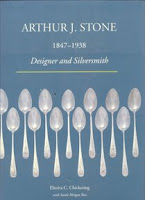
Copyright 1994 Boston Athenaum Library, Boston, MA. Design and production by Elizabeth M. Burke. Copyright 1992 Kenneth Rosen. Designed and edited by Elizabeth M. Burke. Printed at the Ascensius Press, Maine. Other books I've copyedited, designed or produced: Barthel, Diane. The Preservation Project. New Jersey: Rutgers University Press. Germain, Sylvia. The Book of Nights. Boston, MA: David R. Godine Publisher. Kennedy, Rick, ed. Aristotelian and Cartesian Logic at Harvard: Charles Morton's a Logick System & William Brattle's Compendium of Logick. The Colonial Society of Massachusetts Mundy, James. No Rich Men's Sons. Maine: Harp Publications, 1996 Patten, Robert L. George Cruikshank's Life, Times, and Art. Vol 2. New Jersey: Rutgers University Press. Zallen, Doris K. Does It Run in the Family. Consumer's Guide to DNA Testing for Genetic Disorders. New Jersey: Rutgers University Press, 1997.

Long Island, ME: Summer Recycling Creativity 2007

Architects are taking old train crates to make homes. Someone has turned old vinyl records into bowls. Someone else has come up with a lighter-weight "concrete block" for building houses with, by mixing concrete with chewed up styrofoam from styrofoam cups and the like. People make shoes out of cut-up tires. And then there are people who take old furniture and rehabilitate it, or use the wood to create something new. Your mission for this summer class is to come up with ideas, concepts, and then a project for stuff that washes up on the beaches or is on Long Island already. Yep ... recycling. Or, alternately, to come up with an idea about how Long Island can recycle its own everyday "waste" into products. You will come up with not just an idea, but work to transform that idea into a product. You will be engaged in politics, social policy, beliefs, engineering, design, and creativity: first to some up with an idea, then to transform the idea, and all during this proc...

Book Design 1: Letterpress Printing & Creativity

Image
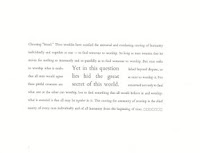
In 1990, I worked with a letterpress shop and the Portland School of Art, with a group of talented students interested in book design and the old-world art of letterpress. I wanted the students to learn more than skill; I wanted them to try to turn the words of a great mind and soul into something worthy of great skill. The work exhibited in the next two slides shows not only how clever they were individually, but how they inherently, long before the "team" work skills became so prevalent in our US of A, did what could be nothing less than brilliant as a team. I gave the assignment, but they did the work, and it was very fine work.

Images and Arrangements

Image

landscape and identity

Image
This is an image taken from a dream, but surely someone knows the feeling of swimming at night, and that is not a dream. To swim at night, in the ocean or a lake, tell me, what is the feeling? What images would you use to describe your sensations and your thoughts? This image is one I have worked over and over, erasing and redrawing, since 1997, and it is now 2007 -- so for ten years. For me, it holds some of the mystery of swimming at night. A person, an animal, a house: the shadows a bit obscure, but the sense of containment and wildness there.

continuing ... memory and architecture

Image
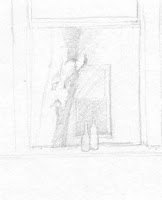
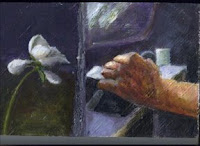
Window and tree, or windows and tree ... views from one way considered from another. When did I do this image? When would someone else have done this image, or wanted this sort of image? When would someone want an image of a tree caught between two windows, on either side of an architectural/continental divide? I did it when I was thinking of going into medicine, after a life-time of wanting/hoping to be a writer, or its defunct (to me), a painter: A person who had the fantasy of being noticably by what she had to say. As a painter, it was as someone who was noticable by what she could image forth. No one wants to be "something" (a painter, a writer, an accountant, etc), without wanting to be noticed for something, or at least to have experienced at some point that one's skills were well put. One hardly waits around to be nothing. And yet, recently, I found myself strangely overjoyed by a small moment in the movie Man on a Train, where the poetry teacher in a small French...

memory and architecture

Image
It is both the arrangement of images/things in our day-to-day lives and in our dreams that leads us to what is compelling us either toward death or toward life. It isn't the things or the images, but how we arrange them--that say something about how we live. Archeology, the prototype for psychoanalysis, really is about studying how things were arranged, so that someone later made an hypothesis about what a culture or civilization valued and how they lived. How we order what we order, or arrange, speaks of our values and desires. These images are not simply images, but arrangements, orderings, and implications.

The Diary Worth Publishing

I've kept a personal journal for years, and about 15 years ago started rereading and then trashing journals from childhood. Really, they were incredibly boring, repetitious, obsessive. I reread them for my own memories, but felt they simply wouldn't be things I'd like to leave for others to read. There are journals worth reading. The writings of Winston Churchill, of Virginia Woolf, the diaries of Anais Nin, or the journals as novels of Doris Lessing. However, I've always wanted to have some sort of worthy journal. One friend notes down all the books he's read, movie he's seen, etc., and he makes small notes to himself about his impressions. So: Diamond, Jared. (2005). Collapse. NY: Penguin Press Science. I read this after having read a manuscript about anxiety disorders, written by a bright and interesting psychiatrist, with whom I'd hope to work on a manuscript, as a copyeditor, editor, co-writer. I started delving back into genetics, biochemistry, etc, ha...